A security policy is a formal set of rules that defines how your organisation protects its information assets and systems. It outlines the necessary actions to prevent unauthorised access, use, disclosure, modification, or destruction of data and infrastructure.
If your business handles sensitive data - such as customer information, financial records, intellectual property, or confidential communications - a security policy is essential.
Why a Security Policy Matters
A security policy helps manage security risks and incidents in a consistent, structured manner. It clearly sets expectations for employees, customers, and partners, establishing accountability and trust. In regulated industries, a formal policy is often mandatory to demonstrate compliance with legal and regulatory standards.
A well-defined, regularly updated policy signals that your organisation is prepared to handle the potential impact of a data breach or cyber incident. It also helps build credibility and demonstrates that you take security seriously.
However, developing a strong policy isn’t a one-off task, it must evolve alongside your business and the threat landscape.
How to Get Started
Define Objectives and Scope Clarify the goals of your security policy: what assets and systems it covers, who is affected, and how the policy supports your broader business strategy and values.
Conduct a Risk Assessment Identify the key threats and vulnerabilities facing your organisation. Where are the gaps? What risks are most severe? This assessment helps define the right controls and priorities.
Set Security Requirements Use the insights from your risk assessment to define specific rules, standards, and minimum expectations. These should apply to staff, partners, contractors, and any other third parties with access to your systems.
Communicate Clearly Use plain, accessible language to explain the policy. Avoid jargon. Many staff members won’t be security experts. Everyone needs to understand and accept their responsibilities.
Implement and Enforce Define clear steps for compliance. Provide training, tools, and ongoing support. Establish processes for reporting incidents, conducting audits, and updating the policy.
Evaluate and Improve Regularly assess how well your policy is working. Gather feedback, track effectiveness, and adjust as needed to reflect changes in your business or the threat environment.
Key Areas to Cover in Your Policy
Your security policy should address multiple aspects of information security. Core areas include:
Password Management Require strong passwords and multi-factor authentication.
Access Control Follow least privilege or zero-trust principles. Give users only the access they need.
Data Encryption Encrypt data both at rest and in transit using current best practices.
Employee Training Educate staff on password hygiene, phishing, and incident response.
Third-Party Access Ensure vendors and partners follow the same security standards as your internal team.
Network Security Implement and maintain firewalls, intrusion detection systems, and VPNs for secure remote access.
Mobile Device Management Apply security controls to work devices - such as strong passcodes, remote wipe capabilities, and device encryption.
A comprehensive, realistic, and regularly maintained policy fosters a culture of awareness and helps the entire organisation remain resilient against evolving threats.
How BMIT Can Help
BMIT provides a number of related services to help businesses with audits and compliance if they don't have the necessary expertise or resources. Want to create a robust security policy that protects your business? Contact us today to get started.
Learning how to prompt effectively is key to making the most of generative AI tools like Microsoft’s Copilot. As powerful as the algorithms are, how users interact with them makes all the difference. A well-crafted prompt improves the quality and relevance of the output.
The Basics of Prompting
A prompt in the context of generative AI is the initial input provided to the system to generate a desired output. This input can range from a simple question to a detailed description, depending on the complexity of the task.
Crafting Effective Prompts
Be Specific and Clear: The more specific the prompt, the more accurate the output. Vague prompts can lead to generic or irrelevant responses. For instance, instead of asking Copilot to “write about AI”, a more effective prompt would be, “Explain how AI can enhance productivity in the workplace.”
Provide Context: Contextual information helps AI understand the background and nuances of the task. This can include the target audience, the purpose of the content, and any specific points that need to be covered.
Set Clear Objectives: Define what you want to achieve with the AI’s assistance. Whether it’s drafting an email, creating a code snippet, or generating a report, stating the objective helps in aligning the output with your expectations.
Ready to unlock the full potential of generative AI with expert guidance? Fill in the form below to learn how we can assist you in achieving more with Microsoft Copilot and other AI solutions!
Examples of Effective Prompts
Content Creation: “Draft a blog post about the benefits of remote work for technology companies, focusing on increased productivity, reduced overhead costs, and access to a global talent pool.”
Technical Documentation: “Write a user guide for setting up a home Wi-Fi network, including steps for choosing a router, connecting devices, and troubleshooting common issues.”
Email Marketing: “Create a marketing email for our new fitness app, highlighting its personalized workout plans, real-time progress tracking, and community support features. Target audience: young adults aged 18-35.”
Customer Support: “Generate a response to a customer complaint about delayed delivery, emphasising our commitment to service, the steps we’re taking to resolve the issue, and an offer of a discount on their next purchase.”
Social Media Content: “Write a LinkedIn post announcing our company’s latest software update, detailing the new features and improvements, and inviting users to join a webinar for an in-depth demonstration.”
Code Generation: “Create a Python script that reads a CSV file of sales data, calculates the total sales for each product category, and outputs the results in a new CSV file.”
Business Proposals: “Draft a business proposal for a new client outlining our digital marketing services, including SEO, content marketing, and social media management, with a focus on increasing their online presence and engagement.”
Educational Content: “Write a lesson plan for senior school students on the basics of climate change, covering causes, effects, and potential solutions, with interactive activities and discussion questions.”
Data Analysis: “Analyse the attached sales data for the past year and provide a summary of key trends, including seasonal variations and top-performing products, with visual charts and graphs.”
Creative Writing: “Write a short story set in a dystopian future where AI governs human society, exploring themes of freedom, control, and the human spirit.”
Repetition and refinement
If the initial output is not as expected, refine your prompt and try again. Providing feedback on what was missing or incorrect in the previous output can guide the AI towards better results.
Check the output
AI-generated content can sometimes include inaccuracies, biases, or misinterpretations of the prompt due to certain limitations. Therefore, reviewing and editing AI-generated content helps ensure factual accuracy, alignment with ethical standards, and overall quality.
Conclusion
As AI continues to evolve, the ability to craft effective prompts will become an increasingly valuable skill, empowering users to achieve more with these advanced tools. We understand the transformative power of generative AI and are here to help you harness it. Whether you're looking to improve content creation, streamline technical documentation, or enhance customer support, our experts can guide you in crafting effective prompts and integrating AI tools into your workflows.
Ready to unlock the full potential of generative AI with expert guidance? Fill in the form below to learn how we can assist you in achieving more with Microsoft Copilot and other AI solutions!
Organisations continually face challenges in adapting and innovating to maintain competitiveness. While some challenges arise from market dynamics, others stem from legislative and compliance requirements.
To address these challenges, many organisations, whether by choice or necessity, embrace a framework or standard to streamline processes, enhance overall efficiency, achieve compliance, and, of increasing importance, bolster cyber resilience. Furthermore, adopting such standards can facilitate communication and collaboration within and across the organisation.
The choice of a framework or standard depends on various factors, including the organisation's needs, its specific objectives, legal obligations, and client demands.
For instance, financial services entities may seek compliance with the Payment Card Industry's PCI DSS or the more recent European Union's Digital Operational Resilience Act (DORA). Technology companies might prioritize ISO 27001 or the NIST Cybersecurity Framework, while quality-focused organisations may opt for the ISO 9001 standard. Large enterprises often find value in Cobit 5.
Regardless of the chosen framework or standard, three common elements emerge:
Defining purpose: The organisation selects a framework or standard with a clear purpose in mind, often aligning with industry-specific criteria.
Adherence to criteria: Organisations adhere to specific criteria relevant to their industry when choosing a framework or standard.
Evidence and outcomes: Successful implementation of the framework or standard is a primary outcome, supported by thorough documentation, established processes, and clear responsibilities.
However, it's crucial to recognise that successful implementation isn't solely based on initial adoption. It hinges on a commitment to continuous improvement. Falling into the pitfall of complacency can lead to several challenges:
Without ongoing improvement efforts, processes can stagnate and become outdated, impeding adaptability to changing circumstances.
Over time, inefficiencies can creep into processes, eroding the initial benefits gained from implementing the framework.
Failing to evolve with industry best practices, technology, and methodologies can result in missed opportunities for innovation and growth.
Continuous improvement represents a dynamic approach that necessitates regular assessment, refinement, and optimisation of processes within the framework. Externally, this entails staying updated with industry developments, gathering feedback, and making necessary adjustments to continually enhance performance. Internally, continuously measure, identify failures and inefficiencies, learn from incidents and implement necessary changes, required to always provide a robust echo system on which the organization can continue to grow
Adaptability: It ensures the organisation remains adaptable and responsive to changing business environments, maintaining a competitive edge.
Enhanced efficiency: Regular review and refinement of processes identify and eliminate bottlenecks, reducing waste and increasing overall efficiency.
Customer satisfaction: It helps organisations better meet customer needs and expectations, resulting in higher satisfaction and loyalty.
Compliance: Continuous improvement efforts ensure ongoing compliance with evolving regulations and best practices, preventing costly penalties.
Employee engagement: Involving employees in the improvement process fosters collaboration and innovation, boosting morale and retention.
Innovation: Constantly seeking improvements can lead to innovative breakthroughs and new growth opportunities.
To ensure continuous improvement and valid outcomes, organisations should take the following steps:
Conduct regular assessments of processes to identify areas for improvement, including internal audits, customer feedback analysis, and benchmarking against industry leaders.
Use data and metrics to inform improvement efforts, as data-driven decisions are more likely to result in meaningful enhancements.
Encourage employees at all levels to contribute ideas and feedback for improvement, as they often possess valuable insights into processes.
Clearly document any changes made to processes or procedures resulting from continuous improvement efforts to ensure consistency and compliance.
Keep employees informed about changes and provide training as needed to ensure successful implementation.
Continuously monitor the impact of improvements and be willing to make further adjustments as necessary to achieve desired outcomes.
Frameworks and standards serve as invaluable tools for organisations aiming for efficiency and excellence. Continuous improvement isn't merely a goal; it's an ongoing process requiring commitment, collaboration, and communication from all compliance stakeholders.
Embracing continuous improvement ensures organisations achieve better compliance results and outcomes, while also enhancing their competitive advantage and value proposition.
Cybersecurity is a critical concern for every business though not everyone accepts the facts and by then it is usually too late.
Businesses need to understand how important it is for them to protect sensitive data, intellectual property, and the overall reputation of the business.
Investing in cybersecurity is a cost of doing business but it is a long-term investment in safeguarding against myriad threats.
There are no two ways about it. You need to dedicate a budget to cybersecurity but that does not mean breaking the bank.
The costs after a security breach are very high. Cyberattacks cost businesses nearly $3 billion in 2020. A lot of that damage could have been prevented if those affected had taken basic steps to prevent attacks in the first place. In many cases, basic cybersecurity awareness and staff training can mitigate some attacks, especially phishing attempts that target employees.
What many businesses do not realise, until it is too late, is that if they experience a cyberattack or a breach, it is going to be extremely expensive to remedy the problem.
Limited budgets: Focus on security essentials
Train your employees
Employees can be the first line of defence against cyber threats but they're also the weakest link in the cybersecurity chain. Educating employees about cybersecurity best practices, training them on how to recognise and avoid phishing scams, the importance of strong passwords, and how to handle sensitive data securely, can be done with a very limited budget. There are training platforms that are cost-effective with subscription-based plans for small businesses.
Keep software and systems up to date
Even if you don’t have a vulnerability management program in place, it does not cost your IT team to keep operating systems, software applications, and security software up to date with the latest security patches and updates. If not centrally managed, set up automatic updates on individual machines to ensure critical security fixes are not missed.
Use strong passwords and multi-factor authentication
Encourage employees to use strong, unique passwords that are at least eight characters long and include a mix of letters, numbers, and symbols. Additionally, enable multi-factor authentication wherever possible. This extra layer of security can prevent unauthorised access even if a password is compromised.
Backup your data regularly
It's crucial to back up your data regularly and store backups securely. In the event of a data breach or other disaster, you can restore your data quickly and minimise the impact on your business. There are backup-as-a-service solutions that are not expensive and reduce the need for investment in hardware and other resources.
There are other facets of cybersecurity that could be considered but points 1-4 are a good start if your business has limited budgets or personnel. It’s important to note that just because your business is small, you should not be helpless against cyberthreats. Practical changes requiring minimal effort and cost can help you on the journey towards securing your business.
A security policy is a set of rules and guidelines that define how your business protects its information assets and systems. It establishes what actions need to be taken to prevent the unauthorized access, use, disclosure, modification, or destruction of those assets and data.
If your business deals with sensitive data, customer information, financial records, intellectual property, trade secrets, or confidential communications, you need a security policy!
Security policies are important because they help your business to manage security risks and incidents in a consistent manner. Each policy makes it clear to your employees, customers, and partners what your responsibilities are and what your expectations of them are as well. In regulated industries, a security policy is mandatory for those entities to be compliant with legal and regulatory frameworks.
A well-defined and regularly updated policy is a statement of intent that you are prepared for the likelihood and impact of a security breach or data loss. It also enhances your reputation and trust as a secure and reliable business.
However, creating a strong security policy is not a one-time task. It requires ongoing review and update to reflect the changing needs and threats of your business environment.
Starting the process
Security objectives and scope. Define the goals of your security policy, the assets and systems that need to be protected, the stakeholders and users that need to be involved or informed, and how your security policy aligns with your business strategy and values?
Risk assessment. Creating a baseline is an important step. Identify any potential threats and vulnerabilities and their severity; gaps and weaknesses that may be present. Define the controls and measures in place to prevent or mitigate them.
Security requirements and standards. Based on your risk assessment, identify the specific security rules and guidelines to implement to protect your assets and systems, the minimum security levels and best practices that you expect from your employees, customers, partners, and vendors.
Document and communicate. Using clear and easy to understand language, communicate your security policy to all relevant parties and ensure that they acknowledge and agree to it. Not everyone in your business is IT savvy or knowledgeable on security.
Implement and enforce. Define actionable steps and procedures. Provide adequate training, tools, resources, and support to help your employees, customers, partners, and vendors comply with your security policy. Establish mechanisms for reporting, auditing, reviewing, and updating your security policy on a regular basis.
Evaluate and improve. Monitor the effectiveness and efficiency of your security policy, collect feedback from stakeholders, identify areas for improvement and update accordingly.
Elements of your security policy
You can set and enforce policies that address many security areas. Here are few key areas:
Password Management
One of the most critical components of a strong IT security policy is effective password management using strong passwords, multi-factor authentication.
Access Control
Zero trust or least privilege are two principles to follow. Only give access to those who need it and treat every user as a possible threat.
Data Encryption
Encrypt all data, both in transit and at rest, using industry-standard protocols.
Employee Training
Training employees on best practices for password management, data security, and incident response to help prevent security breaches and mitigate the impact of any incidents that occur.
Third-Party Access
Ensure third-party vendors / contractors follow the same IT security policies as your employees.
Network Security
Ensure that firewalls, intrusion detection systems, and other network security measures are in place and functioning correctly. Consider VPNs for secure remote connections.
Mobile Device Management
Develop strong policies for securing and managing mobile devices, enforcing strong passwords and remote wiping capabilities, among others.
A security policy is a crucial component of an organization's security strategy, providing direction and guidance for creating a secure environment, fostering a culture of security awareness, and enhancing resilience against threats. A comprehensive, consistent, realistic, and adaptable security policy sets the tone for how security is prioritized and implemented throughout the organization.
How can BMIT help?
If you are relatively new to cybersecurity and creating a security policy for your business, BMIT has a Cybersecurity Assessment Tool that will identify weaknesses in your enterprise IT security and offer recommendations. Our solutions architects can then help you fill in the gaps in your security posture with a detailed report on what is needed.
Want to learn more about creating a solid business security policy and strengthening your business’s security posture?
Plan smarter, collaborate better and ship faster with a set of modern dev services; all available on Microsoft's Azure platform. Working with Microsoft through our strategic partnership, it’s clear DevOps has become increasingly critical to a team’s success. Azure DevOps captures over 15 years of investment and research in providing tools to support software development teams.
The services span across the whole development lifecycle to enable developers to ship better quality software, faster. They represent the most complete offering in the public cloud.
Azure Boards - Powerful work tracking with Kanban boards, backlogs, team dashboards, and custom reporting.
Azure Pipelines - CI/CD that works with any language, platform, and cloud. Connect to GitHub or any Git repository and deploy continuously.
Azure Artifacts - Maven, npm, and NuGet package feeds from public and private sources.
Azure Repos - Unlimited cloud-hosted private Git repos for your project. Collaborative pull requests, advanced file management, and more.
Azure Test Plans - All in one planned and exploratory testing solution.
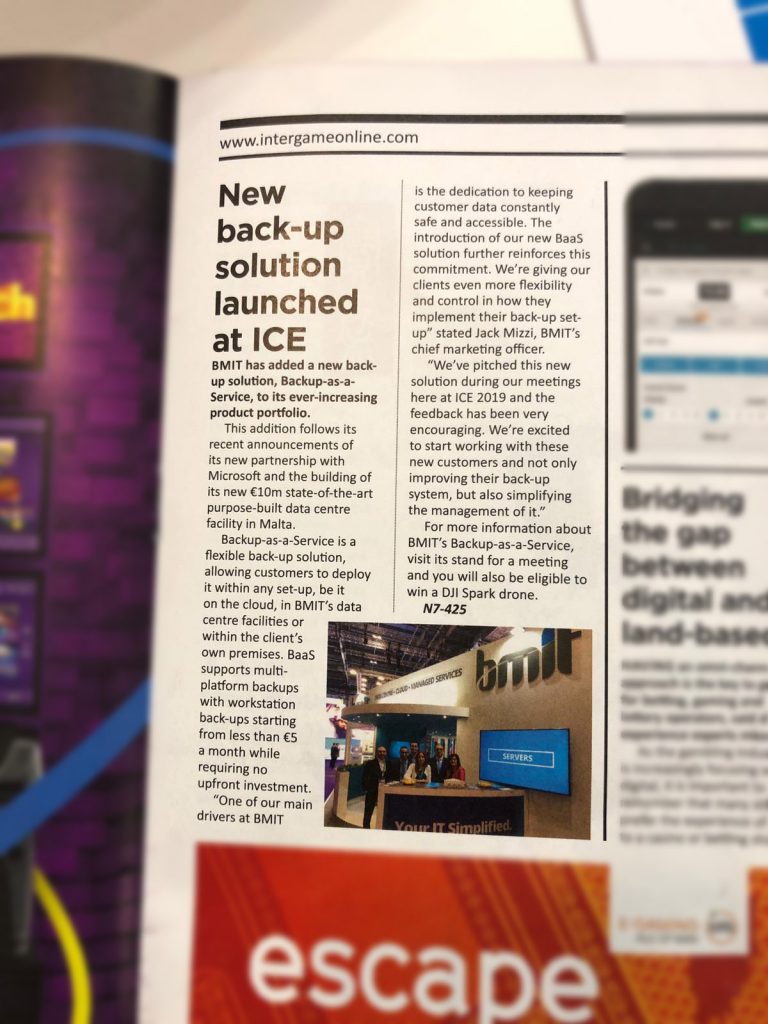
BMIT have added a new backup solution, Backup-as-a-Service, to their ever-increasing product portfolio. This addition follows their recent announcements of their new partnership with Microsoft and the building of their new €10m state-of-the-art purpose-built data centre facility in Malta.
Backup-as-a-service is a flexible backup solution, allowing customers to deploy it within any setup, be it on the cloud, in BMIT’s data centre facilities or within the client’s own premises. BaaS supports multi-platform backups with workstation backups starting from less than €5/month while requiring no upfront investment.
“One of our main drivers at BMIT is the dedication to keeping customer’s data constantly safe and accessible. The introduction of our new BaaS solution further reinforces this commitment. We’re giving our clients even more flexibility and control in how they implement their backup setup” stated Jack Mizzi, BMIT’s Chief Marketing Officer, further commenting, “We’ve pitched this new solution during our meetings here at ICE 2019 and the feedback has been very encouraging. We’re excited to start working with these new customers and not only improving their backup system, but also simplifying the management of it”.
This article was featured on the Day 3 ICE Daily issue, published during ICE 2019 which is being held between the 5th and 7th of February.
BMIT are looking to the East in a search for growth that has taken it to global gaming expo G2E Asia 2018 in Macau. The G2E Asia trade show is of critical importance for the gaming industry and BMIT pulled out all the stops at their stand, where they showcase all their latest, cutting-edge services to delegates from the gaming and entertainment industry.
What is G2E Asia?
The G2E Asia summit is widely regarded as the marketplace for the Asian gaming and entertainment industry, and BMIT was present this year alongside other key industry players.
Held in Macau, the G2E Asia event is an annual expo organised by the American Gaming Association (AGA) and Reed Exhibitions. From its debut in June 2007, in a little over ten years, this expo has become the leading industry event in the Asian market, allowing professionals to network, discuss innovations, share knowledge and ideas, and exchange experiences on this dynamic industry.
Why is it important?
As happens every year, G2E Asia welcomed over 95% of all Asian casino operators, offering the perfect access point for European investors and operators who want to tap into the Asian market. The exhibitor list is a “who’s who” of industry players, ranging from compliance, to payment processing, to training consultancy providers, with a healthy dose of gaming content, software and technology thrown in.
How did it go?
BMIT’s cloud-based IT-outsourcing services drew a lot of interest from summit attendees and investors. By all accounts, the event was a roaring success for both organisers and exhibitors alike.
“The company has its sights fixed firmly on the Asian market” said Nick Tonna, CCO at BMIT. “During our three days in Macau we received very positive feedback and look forward to serving Asian operators seeking to establish presence in the EU and acquire a Maltese Remote Gaming license”, Mr Tonna added.
Reality check: Modern businesses rely on their digital capabilities now more than ever. Downtime has become a terrifying thing to even utter, let alone consider. This is why an effective Business Continuity Plan has become a cornerstone in every business, with IT-centric businesses being no exception. Business Continuity is all about identifying what your key products are and what you can do to ensure that business continues as usual even in the case of disruptions or catastrophes, no matter the size or cause.
In truth, Business Continuity Planning is not such an alien concept even to regular consumers. Ever planned a holiday? Whenever planning a holiday, we think of the worst case scenarios and how we can come out of them unscathed, without ruining our well-earned trip. We setup plans in case something goes wrong with our “core services” and we’re prepared for it. We search for additional taxi services in the area despite having booked a cab already, or we check for alternate routes should we rent a car. It’s never a good idea to go on a vacation unprepared for something to go wrong, and a business should be no different.
Being the largest multi-site data centre provider in Malta, we are experienced in the business of keeping our customers’ systems online at all costs. The ideal IT services provider should strive to deliver a redundant solution in every component within their setup. At BMIT, we take great care in adopting this approach, from upgrading our core infrastructure services all the way to training our technical team to adopt best-practice methods for optimal business continuity management. Improving redundancy should always be the utmost priority when it comes to introducing new products within an IT Services provider’s portfolio.
Studies show that the average total cost of unplanned application downtime per year is €1 billion to €2.5 billion for the Fortune 1000 companies. An hour of infrastructure failure costs an average of €100,000 with the number jumping fivefold to €500,000 to €1m in the case of a critical application failure; certainly not numbers to scoff at.
The digital world undergoes changes every day and it is imperative to constantly keep working to ensure that the systems are up-to-date and relevant to the present realities. The introduction of new ranges of systems and services that protect customers against common business continuity pitfalls always helps to cement the provider’s commitment to ensure the clients’ uptime.
With the world fast approaching an almost completely digitally-dependent era, the dangers of the dark side of the internet become an ever-present reality for the modern digital business. In recent years Distributed Denial of Service attacks, otherwise known as DDoS attacks, have emerged as one of the most disruptive ways in which a business can be brought down to its knees. DDoS attacks are weapons of mass disruption aimed at paralysing internet systems including networks, websites and servers, resulting in lost revenues, compromised site performance and tarnished reputations.
BMIT has had to take these dangers into consideration, especially since even ISPs can be targeted, which would put us at a risk of not being able to provide a connection for our customers. In recent years, we’ve launched a multi-tiered DDoS protection and mitigation system to protect our customers from even the most vicious of DDoS attacks.
From our experience in the industry, we learnt that best-practice is for our private network’s bandwidth needs to be sourced from multiple providers and delivered across multiple redundant links in order to eliminate the risks of our customers going offline through an outage. This setup ensures that our clients are hosted on a reliable and certified ISO27001 network which does not rely on a singular connection.
We at BMIT offer our clients various features which help ensure continuity for their business. As we’ve mentioned previously, we now have a multi-tiered DDoS protection and mitigation system protecting our redundant 40gbps private international network. This network consists of multiple geographically-separated links, each of which can take over traffic load should there be any faults in the other links.
Moreover, we have multiple data centres and international points of presence which form a key part of business continuity plans for our customers. Geo-redundancy is a critical aspect of business continuity for international customers, and our presence across countries addresses this. For example, some clients mirror their servers from one data centre to another. In addition, we also offer several backup options as well as managed services options to help our clients achieve a robust business continuity plan.
As part of our portfolio, our customers can also tap into several tools to manage their systems, including advanced firewall solutions as well as virtual load-balancing services. Ultimately, each of our redundant service offerings is a step forward in our customers’ pursuit to ensuring their business stays up in the face of disasters like outages.
Customers’ feedback is absolutely vital and should always be taken into consideration. Service providers’ good business continuity practices are consistently one of the top priorities for clients and are usually the main reason why providers with great core infrastructures for business continuity retain their customers.
At BMIT, we strive to provide our customers with a premium service and the best possible connectivity. As Malta’s largest multi-site data centre provider, with data centre presence in Italy and Germany, BMIT provides its customers with the faswww and most secure connection out of Malta to mainland Europe. With an entirely new 40Gbps network dedicated solely to BMIT clients, and protected by a multi-tiered DDoS protection and mitigation platform, peace of mind for our customers is our top-most priority. We also work in conjunction with leading Tier 1 providers to provide best-of-breed services for our esteemed clientele.
Over the years BMIT has also established itself as Malta’s largest and most experienced IT solutions provider of services to industries who have a high dependency on being always online, such as iGaming. These investments further enhance BMIT’s leadership in the local market in this critical business segment. In fact, the majority of iGaming operators in Malta trust BMIT to keep their services up and running 24/7.
With optimal real-time performance being a critical requirement for online gaming operators, BMIT’s investment in a new private network effectively eliminated all hops up to Italy and Germany. This upgrade means that our performance is now comparable to mainland Europe service providers, while our international presence enables our clients to choose between hosting in Malta or data centres out of Malta, such as Italy and Germany. Following the deployment of this network, we have received excellent feedback from clients regarding available capacity, latency and overall performance.
While top-notch performance is crucial in a network, protecting it is equally as important for online businesses. The internet is under heavier attacks than ever. Not only are DDoS attacks on the rise, but they are also increasing in size. According to major industry players, in the first half of 2016, there was a 73% increase in peak attack size over 2015. In past years, attackers would see that a site or network was protected and just find another target instead of wasting their time on a secured setup. Nowadays, they keep their attacks up, hoping that the defences might drop. Gaming operators are not immune to this, and although there is no specific pattern of attack, we do notice increased activity around international sporting events.
BMIT provides a multi-tiered DDoS protection and mitigation service. Key elements of the solution are an upstream scrubbing centre and inline traffic analysers and scrubbers. Whereas the upstream scrubbing centre mitigates the high volume attacks, the inline scrubbers help with the monitoring and fine-detailed scrubbing and gathering of real-time information.
Upgrades to our network infrastructure were our biggest priority last year, however, to ensure that our portfolio fully addresses our ever changing customer needs, over the recent years, we have undergone a full transformation of our service offering. As a result, we have shifted ourselves from a traditional colocation and hosting provider to a fully-fledged IT solutions provider. BMIT’s services do include not only co-location and hosting but also a full suite of cloud-enabled services as well as the ability to offer our customers managed services and solutions.